.png&w=128&q=75)
By Daikimeida team | Tue Oct 13 2026
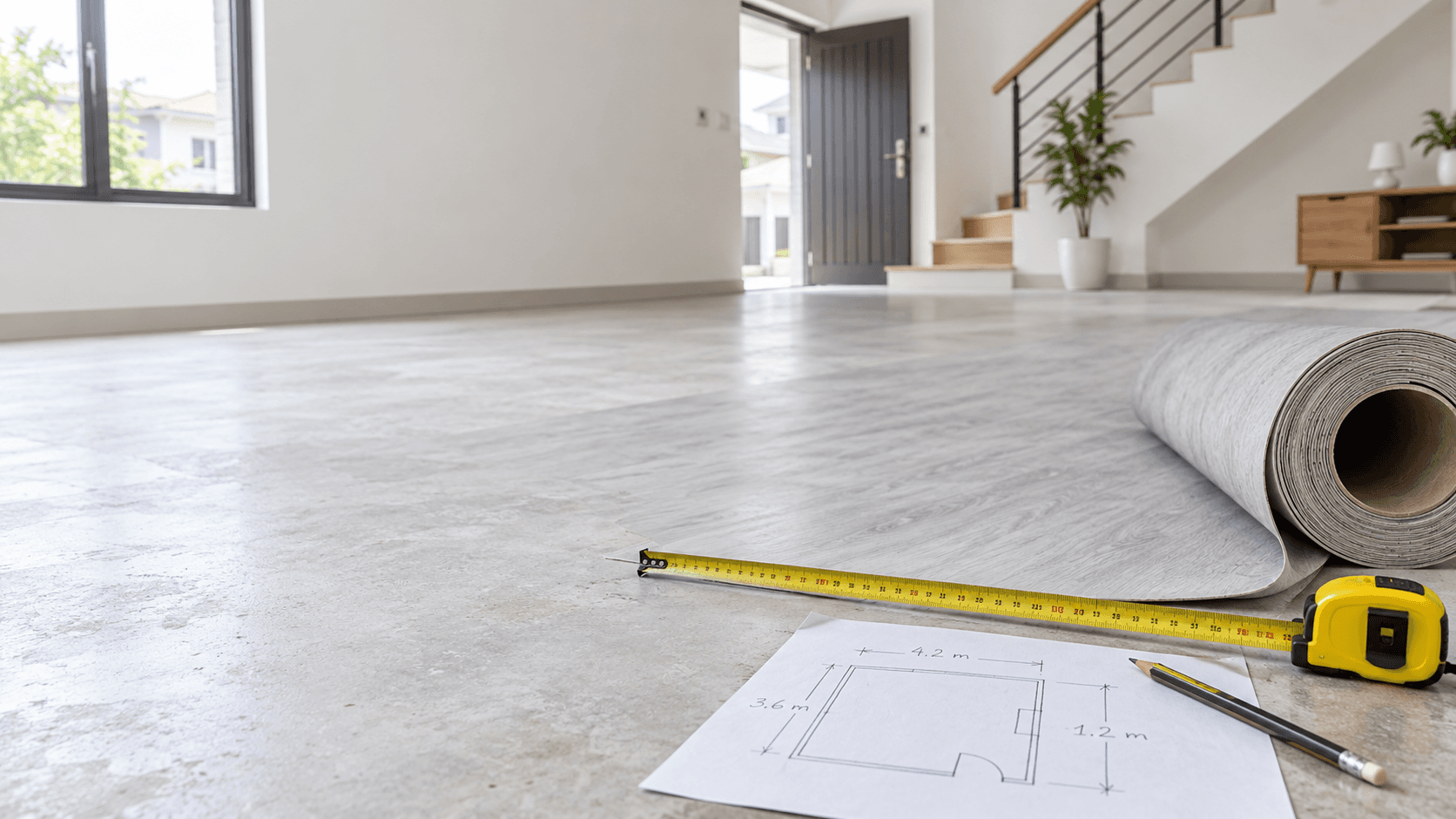
Most flooring mistakes happen before the roll is even ordered. Someone eyeballs the room, rounds down to be safe, and the installer arrives with vinyl that stops 30 cm short of the far wall. Or it goes the other way, and half a roll sits in a store room for years.
Working out how much vinyl sheet flooring you need takes a tape measure, a pencil and about twenty minutes. Here is the method we use with customers, plus a real example you can copy.
Tiles and planks are sold by the box, so you work out the floor area, add a little extra and count boxes. Sheet vinyl comes on a roll with a fixed width, which means you are really buying a length, not an area.
That changes the maths. A room 3.2 m wide can’t be covered by one 2 m strip, so you need two, and the unused part of the second strip gets trimmed off. Calculate area alone and you will almost always order too little.
Roll widths vary between ranges and aren’t always listed online. Tapiflex Essential 50 in Chambray Light Grey, for example, is supplied in 20 m rolls, but the width is something to confirm before you calculate anything. Decide on the wear layer and finish you want first, then measure.
A metal tape measure (5 m or longer), paper, a pencil, a calculator and your phone for photos. Measure wall to wall, not skirting to skirting, and write everything in metres.
Walls in older terrace houses are rarely straight, so measure each dimension in two or three places and use the largest figure.
Say the roll is 2 m wide.
Floor area
4.5 x 3.2
14.4 m²
Strips needed
3.2 / 2, rounded up
2 strips
Length per strip
4.5 + 0.1 trim
4.6 m
Roll to order
4.6 x 2
9.2 m
Vinyl you pay for
9.2 x 2
18.4 m²
The floor is 14.4 m², but you buy 18.4 m², roughly 28% more. The second strip is 2 m wide and only 1.2 m of it stays on the floor. A quick “area plus 10%” shortcut would tell you to buy 15.8 m², and you would be short.
Take an L-shaped living and dining area. Measure the main rectangle, say 5 m by 3 m, then the extension, say 2 m by 2 m. That gives 15 m² plus 4 m², so 19 m² of floor. Don’t order from that figure.
Lay the sketch out strip by strip instead. Offcuts from one part of the room can often fill another, so waste in one corner becomes usable vinyl somewhere else. Show the sketch to your installer, who can often find a layout that needs a shorter roll than the maths suggests.
On top of the trim allowance, a plain colour in a simple rectangle rarely needs more than 5 to 10% extra. Printed designs and rooms with lots of corners are safer at 10 to 15%. Treat those as rules of thumb and let the installer’s layout overrule them.
A reliable installer will offer to re-measure on site, and you should say yes. Keep an offcut after the job too, because a later top-up can come from a different batch with a slightly different shade.
Bathrooms. Most small bathrooms can be covered in one piece, which avoids a seam in a wet area. If you’re choosing a finish, look at slip-resistant bathroom vinyl options before you order.
Kitchens. Measure into the space under removable appliances. Ask your installer whether to run the vinyl under fitted cabinets or stop at the plinth.
Offices and large rooms. Once a room is wider than the roll, seams are unavoidable, so get the layout planned before you buy. Busy spaces like schools, clinics and offices often suit a hard-wearing range such as iQ Granit, and big open floors are why sheet vinyl is so often a cost-effective choice for large spaces.
A good measurement can’t rescue a poor subfloor. It should be dry, level and clean before anything goes down, and installation and subfloor work can move your total more than the vinyl itself. Many installers also like to leave the roll flat in the room for a day before fitting, so ask whether they want that.
How much extra vinyl sheet flooring should I order?
For plain colours in a simple room, 5 to 10% over your calculated roll length is common. For patterned vinyl or irregular rooms, 10 to 15% is safer. Your installer’s advice should win over any general figure.
Measure in metres, work out the area, then multiply by 10.764. A 14.4 m² floor is about 155 sq ft. You still need to think in roll widths, not just area.
It depends on the supplier. Some sell by the running metre cut from the roll, others by the full roll. Ask how your chosen product is priced before comparing quotes.
Yes. A tape measure and a sketch are enough for a normal room. For staircases, irregular layouts or large commercial floors, ask for a site measure.
A top-up roll may come from another production batch, and the shade can differ slightly. A modest buffer costs less than that risk.
If you’ve done your measurements and want a second pair of eyes, send your sketch to our team and we’ll confirm the roll width and quantity before you commit. You can also browse vinyl sheet flooring in our shop.

Striped vinyl sheet PG20252 – modern stripe design for Malaysian interiors.
Explore this premium flooring solution.
Explore the Versafloor Vinyl Sheet PP20425 – stylish, waterproof, and slip-resistant vinyl flooring perfect for homes and commercial spaces in Malaysia. Durable and easy to maintain.

Discover PG20249 – a soft, matte vinyl sheet that brings modern comfort to homes and offices in Malaysia. Stylish, non-slip, and easy to maintain.